
Micron (MU): Record Quarter, Single-Digit Multiple

01-10-2026 · @Blackintus
The print the market shrugged off
Micron Technology reported fiscal fourth-quarter revenue of $54B, up 379% from a year earlier, with an 87% gross margin and adjusted EPS of $33.42 against consensus of $31.72. The stock traded about 0.5% lower in premarket on Thursday, per MarketWatch.
Options had priced a move of roughly 7% in either direction. That gap is the story. At 6.6 times forward earnings, Micron trades against 18.5 times for the S&P 500, because investors have seen this cycle end before and are not willing to pay for peak margins.
The Blackintus lens: Micron is no longer only selling chips into a cycle. It’s selling multi-year commitments, 26 take-or-pay agreements covering about a third of revenue through 2030, into a supply market that can’t add meaningful capacity before mid-2027. If those contracts hold, the earnings base is more durable than the multiple admits. If they don’t, 87% is the margin the next downturn starts from.
The quarter in numbers
Micron’s fiscal Q4 2026 (May 29 to Sept 3) beat its own guidance midpoint by 8.5% and Wall Street’s revenue estimate by about $3B. Revenue of $54.23B compares with guidance of $50.0B ± $1.0B and a consensus of $51B, per Micron’s 8-K and Barron’s.
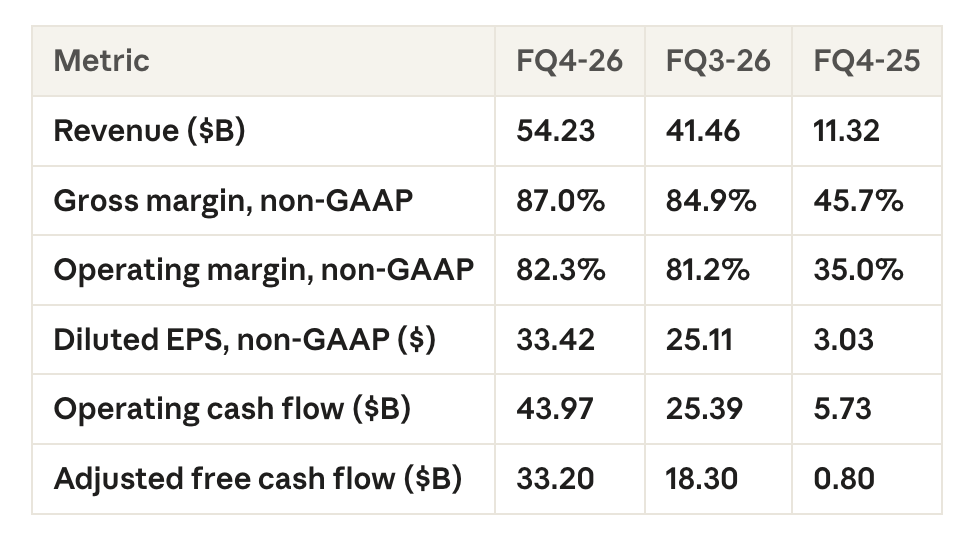
Revenue is up 379% from a year ago and 31% from the prior quarter. Non-GAAP EPS is 11 times the year-ago figure and beat the $31.72 consensus by 5.4%.
The mix shifted faster than the total. Core Data Center revenue went from $1.6B to $18.0B in a year and is now Micron’s largest unit. Mobile and Client earns the same 90% gross margin, so the shortage isn’t confined to AI servers.
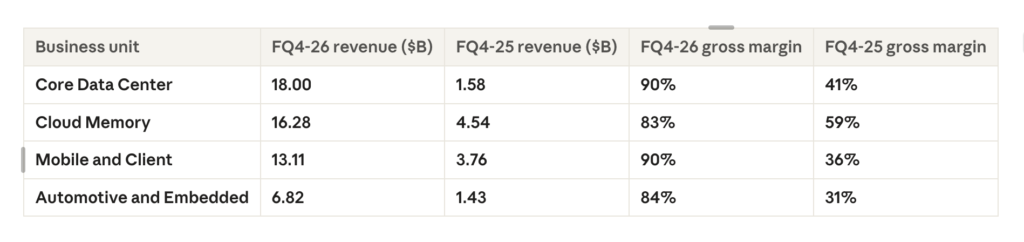
One caution on the sequential comparison. The quarter closed 98 days after fiscal Q3 ended on May 28, which makes it a 14-week quarter by our count, and the fiscal year ran 53 weeks. Micron’s release doesn’t quantify the effect of the extra week.
Why the stock isn’t moving
The options market priced a move of about 7% on this print and got roughly 0.5%, because investors are valuing Micron on where margins go next, not where they are. Shares were 0.5% lower in early premarket trading on Thursday, per MarketWatch.
At 6.6 times forward earnings, Micron trades well below the S&P 500’s 18.5 times, per Barron’s. Analysts expect $160 of adjusted EPS for fiscal 2027. Single-digit multiples are nothing new for a memory maker.
The guidance gives skeptics something to hold. Fiscal Q1 2027 revenue is guided to $61.5B ± $1.5B, up 13% at the midpoint after 31% growth in fiscal Q4. Non-GAAP gross margin is guided to about 86.25%, a 75-basis-point slip from the 87.0% record, with EPS guided to $38.15 ± $1.00.
The consensus arithmetic is demanding. Against $38.15 guided for fiscal Q1, a $160 full-year estimate needs the next three quarters to average about $40.6 by our math. Expect the figure to move: after the last report, analysts raised fiscal 2027 estimates the next day and the stock rose 16%, then faded as skepticism returned.
The old rule on memory is to buy when conditions go from bleak to merely terrible and sell when growth and margins peak. Investors who mistimed the 2022-23 downturn aren’t paying for durability on a record quarter. They want to see it survive a quarter in which growth and margin both slow.
The contracts are the thesis
Supply: why this upcycle is running long
Memory upcycles usually end when new factories open and refill depleted inventories, and this one hasn’t ended because the factories aren’t there yet. Micron, SK Hynix and Samsung held back capital after the 2022-23 downturn, and new fabs aren’t due until the middle of 2027, with more slated after that, per Barron’s.
Prices have risen at the fastest pace on record, and the shortage has reached consumer devices, where 2026 price hikes are now routine. CEO Sanjay Mehrotra told analysts he expects supply-demand conditions in fiscal 2027 and 2028 to be much tighter than in fiscal 2026.
Micron’s own inventory data fits the story. Inventories were $10.4B at fiscal year-end, up 24% from a year earlier, while quarterly revenue rose 379%. There is very little stock sitting behind the shortage.
The company is spending to close the gap. Net capital expenditure was $10.8B in fiscal Q4 and $27.4B for fiscal 2026, roughly double the $13.8B of fiscal 2025, per the 8-K. In March, Micron said fiscal 2027 spending would rise by more than $10B from the prior year, per Bloomberg Government, a paywalled report we read in part.
Open item: fiscal 2027 capex guidance from this week’s call isn’t confirmed here. Check the transcript before relying on the March figure.
Cash: $62B in a year, almost none of it returned yet
Micron generated $62.3B of adjusted free cash flow in fiscal 2026 and ended the year with $73.5B in cash, marketable investments and restricted cash against $5.2B of debt. Operating cash flow was $89.7B, up from $17.5B. All figures are from the 8-K unless noted.
Micron’s adjusted measure nets capital spending against government incentives. Barron’s cites $59B of free cash flow, which matches operating cash flow less gross capital spending of $30.7B. Either way, Wall Street expects $129B for fiscal 2027, per Barron’s, which doesn’t state its definition.
The balance sheet is close to debt-free. Micron repaid $10.0B of debt in fiscal 2026 and carries $5.2B ($0.5B current, $4.7B long-term). Net cash is about $68.3B by our math.
Capital return is small next to the cash pile. Micron bought back $650M of stock under its repurchase program and paid $610M in dividends, about 2% of adjusted free cash flow by our math. It declared a $0.15 quarterly dividend payable Oct. 29 to holders of record on Oct. 14.
Receivables are the line to watch. They reached $36.2B, up from $9.3B a year ago, equal to about 65 days of fiscal Q4 sales by our math, and absorbed $25.2B of operating cash during the year. Our read: the balance sheet gives Micron room to do far more than $650M of buybacks, and the stock’s multiple makes that the cheapest lever it has.
Capital flows: the memory trade is already crowded
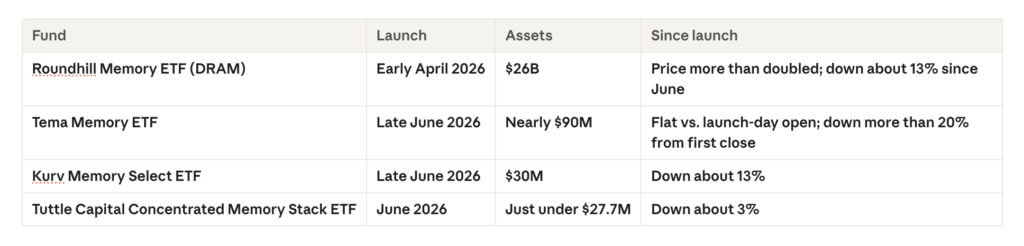
The Roundhill Memory ETF (DRAM) gathered $26B in assets in a little under six months after its early-April debut, and it still trades more than 25% below its June high, per Barron’s. Its price has more than doubled since launch. Micron is the largest holding at more than 26%, which puts at least $6.7B in the stock by our math.
Micron, Samsung and SK Hynix make up nearly three-quarters of the fund. That concentration explains why DRAM swings harder than the iShares Semiconductor ETF (SOXX), which sits about 14% below its 52-week high. DRAM jumped 10% in late June after Micron’s previous report.
The fund trades at five times forward earnings, down from ten times in June, against 19 times for the S&P 500 in Barron’s ETF coverage. Roundhill CEO Dave Mazza told Barron’s that flows during pullbacks show investors treating them as entry points. He sells the product, so read that as a sponsor’s view.
What breaks the thesis
The bear case has four parts: margin, demand, politics and rates.
- Margin is at its ceiling. Gross margin hit a record 87.0%, and the fiscal Q1 guide has it slipping to about 86.25% (see the guidance above). Memory investors have historically sold when growth and margin peak, so any miss on that guide will be read as the turn.
- Demand may be overbuilt. Roughly 509 gigawatts of new US data-center capacity is planned, almost nine times what’s operating, per July data from Cleanview cited by Barron’s. Draft research from Columbia Business School’s Stijn Van Nieuwerburgh estimates 45% of it will never be built.
- Politics now touches the AI trade. Midterms are Nov. 3. Baird strategist Ross Mayfield told Barron’s that local and state pushback could delay data-center projects, and Pew polling shows 54% of Americans see data centers as mostly bad for the environment and 50% say the same for home energy costs.
- AI-safety headlines can hit sentiment fast. OpenAI’s pause on training its latest models set off a sharp selloff on Monday. The market shrugged off the launch cancellation on Tuesday and Micron rose 1.7%, per Barron’s.
- Rates are a backdrop risk. The 10-year yield is more than 50 basis points higher this month and more than 130 higher since the Iran war began, per Barron’s Daily. MarketWatch’s live blog puts it at the highest since 2002.
The pattern from last quarter is the practical risk. Micron rose 16% the day after its previous report, then faded as skepticism returned, per Barron’s. This quarter the first-day move is flat, so there’s no pop to give back.
The Blackintus read
Our read: Micron’s multiple is priced for the cycle’s history, while its balance sheet is already priced for the contracts. Customers have parked $12.9B of deposits with Micron to secure supply, and the company holds $73.5B of cash and investments against $5.2B of debt. The market still pays 6.6 times forward earnings. Either customers are overpaying for supply insurance or the market is underpricing durability, and both can’t be right.
The next print has to settle it. The markers we’d watch:
- Fiscal Q1 revenue inside the guided $60.0B to $63.0B range, with gross margin at or above about 86.25%.
- The contract count and revenue coverage rising from 26 agreements and about a third of revenue.
- Any disclosure of floor and ceiling terms, or the share of volume priced at market.
- Fiscal 2027 capex and fab timing set against the mid-2027 supply date.
- Receivables holding near 65 days of sales as revenue climbs.
Two things would make this read wrong. One is a margin guide that falls by more than the 75 basis points guided for fiscal Q1. The other is contract counts and deposits that stall while capital spending keeps rising.
Analysis, not advice. This is not a position recommendation. Premarket data is from MarketWatch’s Oct. 1, 2026 live blog, last updated 6:20 a.m. ET.