
Robotaxis — A $2 Trillion Market by 2035. Which Companies Will Capture It?
Goldman Sachs calls autonomous vehicles one of the most significant shifts in the transportation industry. We break down the market, the key players, the stocks to watch, and the risks you need to know.
~$2Trillion Total AV industry revenue (robotaxis + trucks + consumer vehicles + software) by 2035
$415Billion Global robotaxi market by 2035. US portion: $48B
30–50% Gross margins for a vertically integrated AV operator — implying ~$150B global gross profit by 2035
6M Commercial AV robotaxi fleet by 2035, up from ~7,000 vehicles in 2024
Why Robotaxis Are a Megatrend, Not Hype
The key question for investors, according to Goldman Sachs analyst Mark Delaney, is no longer “does the technology work?” — it’s “how fast does the market scale?” The answer, based on Goldman Sachs Research, is: very fast. The global robotaxi market is projected to reach approximately $415 billion by 2035, with the US portion alone hitting $48 billion. Autonomous trucking adds another $560 billion globally ($105 billion in the US by 2035). Looking at the full scope of the AV sector — robotaxis, consumer vehicles with advanced autonomy, AV trucks, delivery robots, software subscriptions and digital services — Goldman Sachs estimates total industry revenue could reach approximately $2 trillion by 2035.
An important nuance: not all of that $2 trillion represents new spending. A significant portion reflects existing economic activity shifting from human-operated to autonomous modes. In the US alone, the economic activity subject to disruption — spanning driver wages, rideshare bookings, and possible declines in vehicle sales — is estimated at roughly $440 billion.
Revenue directly tied to AI — virtual driver technology and consumer autonomy software subscriptions — is estimated at roughly $300 billion by 2035. The consumer software opportunity alone could exceed $50 billion for vehicles capable of Level 3 to Level 5 autonomy. This is arguably the most valuable segment from a margin standpoint.
Key insight from Goldman Sachs Research: For a vertically integrated company that both builds and operates its own robotaxi fleet, gross margins could range from 30% to 50% — implying a global gross profit pool of about $150 billion in 2035. Over the next decade, cumulative gross profits from robotaxis alone could total approximately $440 billion. Uber/Lyft drivers currently take home 50–75% of every fare. Robotaxis eliminate that cost entirely.
The Economics Are Shifting Fast
Goldman Sachs models the total cost of goods sold per mile dropping below $1 in the US by 2035 for a vertically integrated AV rideshare operator. Key drivers: vehicle depreciation costs fall from roughly $0.35 per mile in 2025 to about $0.14 in 2035; insurance premiums decline; and remote operator costs drop sharply as the ratio of vehicles per human supervisor improves from 6-to-1 today to 26-to-1 in 2035.
For autonomous trucking, the numbers are even more compelling. The all-in cost per mile for an AV truck is projected to drop from $8.56 in 2025 to just $2.03 in 2035 — while the comparable cost for a human-driven truck is expected to rise from $2.55 to $2.84 over the same period. Goldman Sachs projects AV trucking will become cost-competitive with human-operated trucks in 2028. AV trucks also have a structural advantage: they are not subject to the 11-hour daily driving limit that constrains human truckers.
AV truck cost per mile (all-in) $8.56 $2.03 ↓ 76%
Human truck cost per mile $2.55 $2.84 ↑11%
AV vehicle depreciation / mile ~$0.35 ~$0.14 ↓60%
Vehicles per human supervisor 6:1 26:1 ↑4.3×
AV truck upfront tech cost $125–150K $35–40K ↓~72%
Cost break-even vs. human trucking (US) Expected in 2028
The Scaling Race: Where the Leaders Stand
The global commercial AV robotaxi fleet is projected to grow from roughly 7,000 vehicles in 2025 to about 1 million by 2030, and approximately 6 million by 2035. Leading operators plan to be operating in 15+ cities globally by the end of 2026, with some targeting 20+.
The race is playing out on two fronts: the United States (Waymo, Tesla, Zoox/Amazon) and China (Baidu Apollo Go, Pony.ai, WeRide). Chinese companies are expanding internationally — into the Middle East, Europe, and Southeast Asia — often faster than their American rivals. Goldman Sachs recently raised its China robotaxi forecast to 535,000 vehicles by 2030, with the market growing to $61.2 billion by 2035.
Autonomous trucking is expected to become cheaper per mile than human-driven trucks by 2028 in the US, opening up a parallel opportunity estimated at $560 billion globally by 2035.
5 Stocks to Watch
Below is an analysis of five publicly traded companies with significant exposure to the robotaxi and autonomous vehicle market. This is not a buy recommendation — it’s a research framework for your own due diligence.
Alphabet (Waymo) The undisputed leader in US robotaxis
GOOGL Market Leader
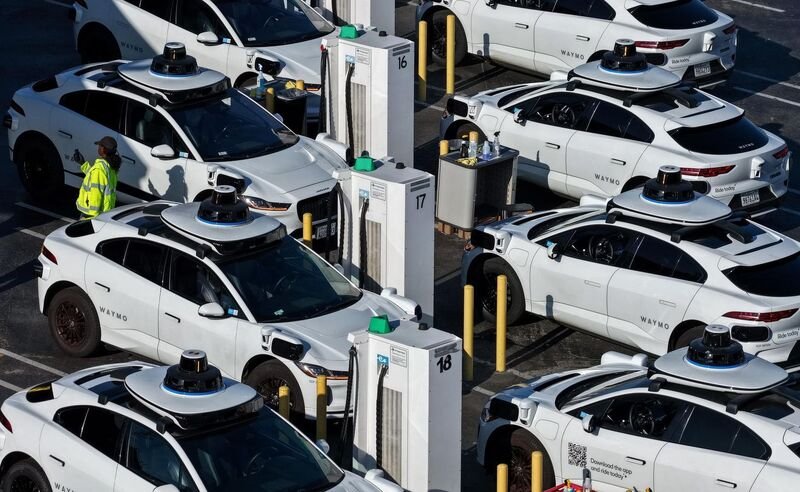
Waymo is the only service in the US offering fully driverless (no human in the vehicle) commercial rides across multiple cities. It now delivers over 400,000 paid rides per week with a fleet of 2,500+ vehicles. Operations span Phoenix, San Francisco, Los Angeles, Austin, Atlanta, and Miami, with expansion planned for Denver, London, Washington D.C., and more.
A multiyear strategic partnership with Uber integrates Waymo rides into the Uber app, dramatically expanding reach. However, Waymo remains deeply unprofitable — Alphabet has reportedly invested an estimated $30 billion into the subsidiary over its lifetime. Waymo generates an estimated $4–5 million per month in revenue, meaning it’s still a moonshot bet relative to Alphabet’s scale.
✦ Growth Drivers Technological leadership (LiDAR + AI stack). Largest fleet and ride count in the US. Strategic Uber partnership. Rapid city expansion including international markets. Alphabet’s deep pockets for long-term investment.
✦ Risks Waymo is a tiny fraction of Alphabet’s revenue — the stock is a diluted proxy at best. Path to profitability remains unclear. Increasing competition from Tesla and Chinese operators. Regulatory uncertainty in new markets.
Tesla Camera + AI: the data scale bet
TSLA High Volatility
Tesla has taken a fundamentally different approach: instead of expensive LiDAR, it relies on cameras and neural networks trained on data from millions of Tesla vehicles worldwide. The Full Self-Driving (FSD) system improves continuously through real-world driving via “shadow mode.” Tesla has launched unsupervised robotaxi rides in Austin, Dallas, and Houston, and plans to mass-produce its purpose-built Cybercab.
Morgan Stanley analyst Andrew Percoco has said Tesla’s ability to scale its unsupervised fleet will be the key stock driver in 2026. The bull case is massive: Tesla could leverage existing owner vehicles to build a fleet faster than anyone. However, early safety data raises serious questions — some reports suggest Tesla robotaxis are involved in accidents at significantly higher rates than human drivers.
✦ Growth Drivers Massive data advantage from millions of vehicles. Low hardware cost (no LiDAR). Owner-operator model — existing Teslas join the fleet when idle. Cybercab purpose-built for mass market. Strong brand and retail investor following.
✦ Risks Safety concerns and crash rate data. Regulatory risk — one bad incident could halt approvals. Reputational and political headwinds. Stock valuation already prices in robotaxi success. Camera-only approach may face limitations.
Baidu (Apollo Go) China’s leader with aggressive international expansion
BIDU Scale Leader
Apollo Go is the largest robotaxi operator in China by fleet size and ride volume. The platform has completed over 11 million autonomous rides across 26 cities, with weekly rides peaking at over 300,000. Uniquely, Baidu doesn’t just develop the AI — it manufactures its own electric robotaxi vehicles at costs 50% lower than the previous generation.
International expansion is accelerating: Apollo Go operates in Abu Dhabi and Dubai, with plans to launch in London, Germany, and the UK through partnerships with Uber and Lyft in 2026. Goldman Sachs recently raised its China robotaxi fleet forecast to 535,000 vehicles by 2030, up from 474,000 previously. However, a March 2026 incident where 100+ Apollo Go vehicles simultaneously stalled on roads in Wuhan raised fleet-level safety concerns.
✦ Growth Drivers Largest scale in China’s robotaxi market. In-house vehicle manufacturing reduces costs. Strong Chinese government support. Aggressive international expansion via Uber/Lyft partnerships. First-mover advantage in Middle East.
✦ Risks Wuhan fleet-level incident (100+ vehicles stalled). Geopolitical risk for Chinese companies. Apollo Go remains unprofitable. Intense domestic competition from Pony.ai, WeRide, XPeng. Regulatory hurdles in Western markets.
Pony.ai Closest to unit-level profitability
PONY Path to Profit
Pony.ai stands out for one critical reason: it’s the only company in the sector reporting a clear timeline to single-unit economic breakeven — targeted for early 2026. The company holds permits for fully driverless commercial service in all four of China’s Tier-1 cities (Beijing, Shanghai, Guangzhou, Shenzhen), with a fleet exceeding 1,400 vehicles.
Its international strategy is focused on the Middle East (Dubai commercial launch in 2026, testing in Doha and Abu Dhabi), Singapore, South Korea, and Europe via a partnership with Luxembourg-based Emile Weber. Pony.ai has also partnered with Uber, positioning it for broader platform integration. Anecdotally, test riders have reported a smoother ride experience compared to Apollo Go.
✦ Growth Drivers Clearest path to profitability in the sector. Permits in all four Tier-1 Chinese cities. Diversified international expansion. Uber partnership for platform reach. Reportedly smoother ride quality.
✦ Risks Small-cap company with significant cash burn. Heavy operating losses despite revenue growth. Geopolitical risk for Chinese companies on US exchanges. Regulatory uncertainty in new markets. Scale disadvantage vs. Baidu.
Aurora Innovation Autonomous trucking — the $560B parallel opportunity
AUR High Risk / High Reward
Aurora takes a different angle: instead of passenger robotaxis, it’s focused on autonomous long-haul trucking — a market Goldman Sachs estimates at $560 billion by 2035. Its “Driver as a Service” (DaaS) model integrates directly into trucks from Paccar and Volvo, with hardware manufactured by Continental using NVIDIA’s DRIVE Thor chips.
Commercial driverless trucking launched in May 2025 on the Dallas–Houston corridor. In May 2026, Aurora signed an agreement with McLane Company (a Berkshire Hathaway subsidiary) for driverless hauls in Texas, expanded its route to Oklahoma City with Volvo Autonomous Solutions, and announced that partner Hirschbach Motor Lines plans to own 500 Aurora Driver-powered trucks. The company is on track to put hundreds of driverless trucks on the road in 2026.
✦ Growth Drivers Deep OEM partnerships (Volvo, Paccar, Continental). Strategic NVIDIA collaboration. Real commercial revenue-generating routes. Massive addressable market ($560B). Addresses structural truck driver shortage.
✦ Risks Essentially pre-revenue ($4M TTM vs. $13.9B market cap). High cash burn ($201M net loss in Q2 2025). Execution dependency on OEM partners. Intense competition. Cash runway extends only to mid-2027.
Also worth noting are companies that benefit indirectly from the AV boom: NVIDIA (NVDA) supplies the chips powering most autonomous driving platforms. Mobileye (MBLY) controls roughly 70% of the foundational ADAS chip market, with its EyeQ processors embedded in over 200 million vehicles. Uber (UBER) is positioning itself as the aggregation platform for all robotaxi operators through partnerships with Waymo, Pony.ai, WeRide, and others.
💡 Investor Tip: Sell Picks and Shovels, Don’t Pan for Gold
During the Gold Rush, the biggest fortunes weren’t made by prospectors — they were made by the people selling picks and shovels. In the robotaxi world, the “picks and shovels” are the companies supplying critical infrastructure to every operator:
NVIDIA — its DRIVE Thor chips power systems from Aurora, Waymo, Baidu, and dozens of others. Mobileye — EyeQ chips are installed in 200+ million vehicles, creating massive switching costs. Hesai Technology (HSAI) — the largest LiDAR sensor supplier, having driven costs down 99.5% over several years.
⚠️ Disclaimer. This material is for informational and educational purposes only and does not constitute personalized investment advice. All investment decisions are made at your own risk. Before making any trades, conduct your own research or consult with a qualified financial professional. Mention of specific companies and ticker symbols does not constitute a recommendation to buy or sell securities. Past performance does not guarantee future results.